
Production Reality of Smart Contracts
Managing audits, monitoring deployments, proxy patterns, and emergency timelocks.
Let's address the hard, final reality of being a production-grade Web3 engineer:
In Web2, the deployment is just the beginning of a fast, iterative loop. If your Node.js server crashes, you quickly patch the bug in git, run git push origin main, and Vercel redeploys it in 45 seconds. The users barely notice a blip.
In Web3, once you broadcast your deployment transaction to Mainnet, that iteration loop is dead. Your contract is now floating in public space, completely unmodifiable, wide open to attack, and potentially holding millions of dollars of real user capital.
I genuinely felt a huge weight of responsibility when I deployed my first mainnet contract.
To survive in production, you must treat your deployment like launching a manned Space Station.
1. The Metaphor: The Manned Space Station Launch
Imagine launching a high-gravity space station:
- The Audit (Pre-Launch Testing): Before the rocket clears the pad, independent teams of engineers inspect every bolt, run stress simulations, and double-check fuel line seals. They do not assume everything will work; they assume something will fail. This is your Smart Contract Audit.
- The Timelock (The Airlock Chambers): If the station crew needs to modify a key system module, they don't do it instantly. They trigger a decompression sequence, wait 48 hours to ensure no alarms are tripped, and only then proceed. This is your Emergency Timelock.
- The Telemetry Sensors (Tenderly / Defender): Mission control sits on Earth, staring at real-time screens monitoring oxygen pressure, power output, and hull vibration anomalies. If a pressure sensor spikes, they get instant pager alerts. This is your Post-Deployment Monitoring.
To build reliable systems, you cannot rely on hopes. You must build structured defensive controls.
A smart contract audit is not a stamp of 100% security. Audited contracts are hacked all the time. An audit is simply a rigorous second set of expert eyes finding standard bugs. Your defense-in-depth architecture—including timelocks, circuit breakers, and real-time monitoring alerts—is what actually saves you during an exploit!
2. The Four Pillars of Production Reliability
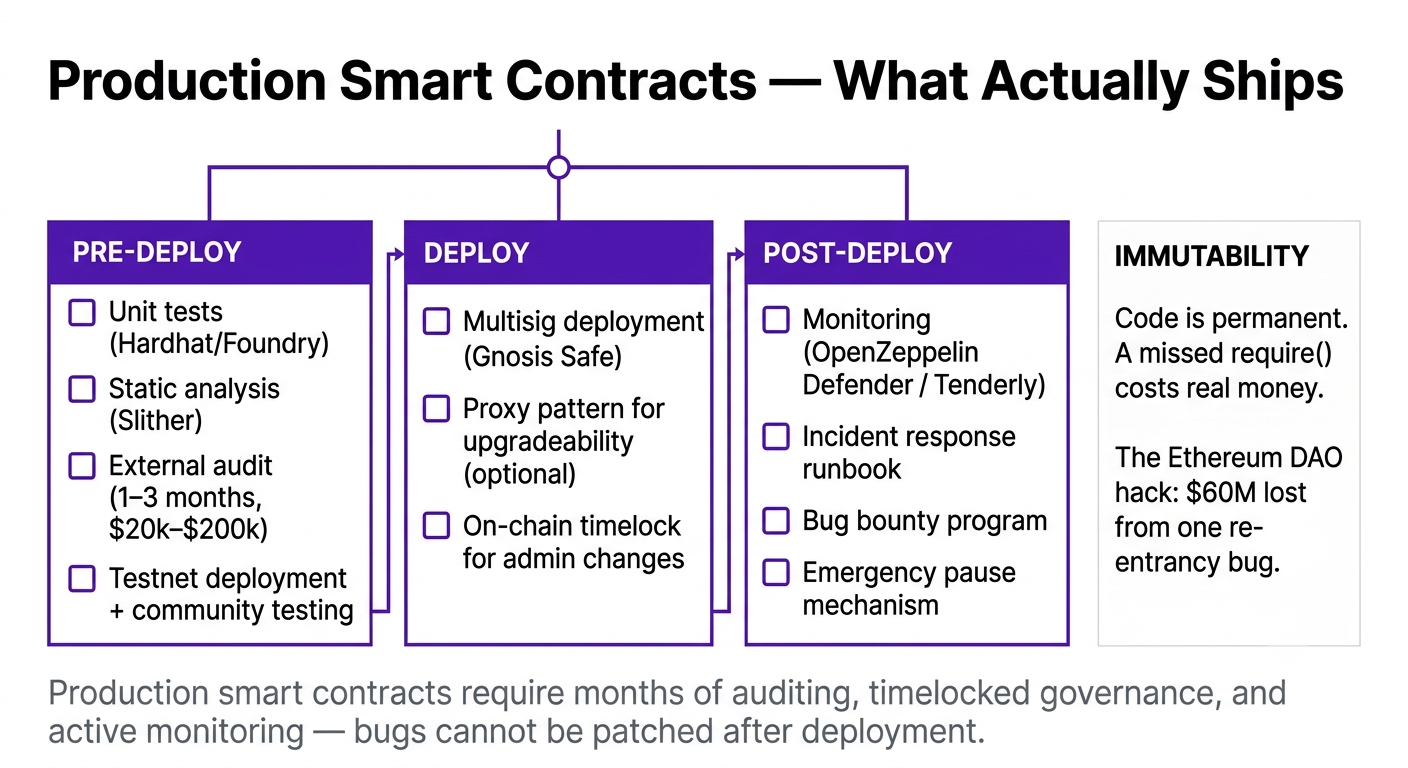
To survive the hostile mainnet environment, every flagship project implements these four pillars:
1. Professional Audits
Before deploying code that handles significant value, you hire specialized auditing firms (like ConsenSys Diligence, Trail of Bits, or OpenZeppelin) to perform a line-by-line security review of your codebase.
2. Circuit Breakers (Pausable Contracts)
You inherit OpenZeppelin's Pausable contract and apply the whenNotPaused modifier to your key state-changing functions. If a zero-day exploit is discovered in production, your monitoring bot or multi-sig admin can call pause() to freeze all transactions immediately, minimizing damage while you coordinate a fix.
3. Timelocked Governance
You bind the administrative roles (like upgrade keys or parameter settings) to a TimelockController contract. When an admin wants to change a fee parameter or upgrade a proxy, the action is placed in a 48-hour queue. This gives users plenty of time to review the change and withdraw their funds if they suspect an admin key compromise.
4. Real-Time Monitoring Telemetry
You configure automated monitoring tools (like Tenderly Alerts or OpenZeppelin Defender Sentinels) to watch your contract address on-chain. If your contract emits an unusual error, experiences a sudden drop in balance, or a blacklisted address attempts to call a function, you receive instant pager alerts to trigger incident response procedures.
The Un-pause Trap: A common incident response mistake is rushing to un-pause a contract after an attack before completely verifying that the attacker's contract state has been disabled. If you un-pause too early, the attacker's script can immediately resume draining the remaining funds. Always coordinate patches offline and verify on local forks first!
3. Case Study: ZeroLeak's On-Chain Timelock Registry
To understand how timelocks are actually written and hard-enforced in production codebases, look at the security contract of the decentralized exam system ZeroLeak.
It uses a hard-enforced, on-chain time gate to prevent exam papers from being decrypted until exactly the start time has passed. Here's a live window into the contract:
Notice these key production architectural patterns:
- The Time Check: The scheduler must pass a
_unlockTimestampin the future (require(_unlockTimestamp > block.timestamp, "Unlock time must be in future")). - The Hard Lock: Any download or decryption share request checks
require(block.timestamp >= paper.unlockTimestamp, "Too early to unlock"). Because this is validated by smart contract consensus on-chain, there is no admin backdoor that can leak the papers early.
Think about how a project team performs a smart contract "upgrade" when a contract is immutable. How do they swap the old code for the new code without changing the address coordinate that users connect to? Hint: look up the "Proxy DelegateCall Pattern" (UUPS).
Was this lesson helpful?
Let us know what you think of this specification. (submitting anonymously)