
Structs and Data Modeling
Modeling users, custom nested struct arrays, and on-chain database schemas.
Let's address a classic Web2 developer habit:
When designing a user database schema in MongoDB or PostgreSQL, we are highly generous with fields. We create nesting structures, add full dynamic sub-lists (posts: Array<Post>), write long text strings for user Bios, and store timestamps freely. In Web2, data storage is essentially free.
I genuinely carried this exact habit into Solidity early on. I designed a User struct that looked like this:
My code worked in local sandboxes. But under production load, a simple register call cost users $12 in gas. The dynamic bio strings, on-chain lists, and unpacked integers were hemorrhaging gas on every write.
To build production-grade Solidity contracts, you must learn to pack your custom Structs with strict, mathematical restraint.
1. The Metaphor: The Airline Carry-On Backpack
Imagine you are packing a single carry-on backpack for a long budget airline flight:
- The airline enforces a strict box size rule: the bag must fit inside an exact 32-liter metal box (our 32-byte Storage Slot).
- If you throw loose, unpacked clothes inside the bag, it bulges instantly, and the airline gate agent forces you to pay a massive $100 penalty fee (costs an extra 20,000 gas slot).
- Instead, you buy packing cubes, roll your shirts tightly, squeeze the air out, and group small items together. By packing compactly, you fit the exact same amount of cargo into a bag half the size, paying zero fees.
Declaring variables inside a Solidity struct is exactly like packing this bag. By ordering variables by size, the compiler automatically compresses them to squeeze into as few storage slots as possible.
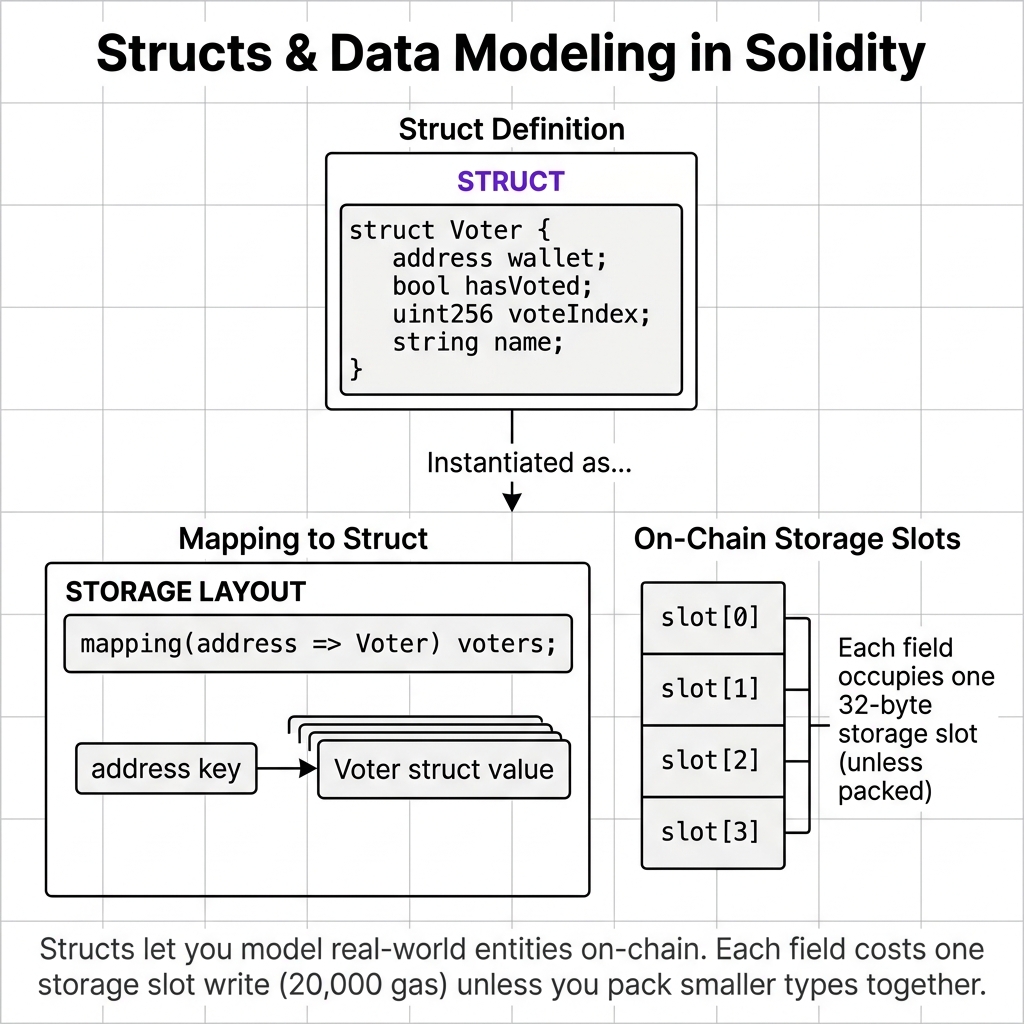
Solidty compiles struct variables sequentially. If you place a large 32-byte variable (like uint256) between two smaller variables (like uint128 or uint64), you block the compiler from compressing them. Always group smaller integer types sequentially by size inside your structs!
2. Technical Breakdown: Struct Packing and Arrays
Let's compare an unpacked struct with an optimized, packed struct:
- Unpacked Structs: In
BadUser, the compiler allocates Slot 0 to the first variable. It seeslastLoginrequires a full 32 bytes, which cannot fit in the remaining 16 bytes of Slot 0, so it pads Slot 0 and starts a new slot. Thenscoreis forced into Slot 2. - Packed Structs: In
PackedUser, the compiler packsregistrationIdandscoreinto a single 32-byte slot (Slot 0), leavinglastLoginto occupy its own clean Slot 1.
The Nested Array Trap: Never store dynamic arrays (like uint256[]) inside a struct that is pushed to a state array. When you load a struct containing a dynamic array, the EVM must calculate dynamic offsets, causing your gas costs to skyrocket. Instead, store those references in a flat, separate mapping(address => uint256[]) lookup.
3. Core Rules of Smart Contract Data Modeling
- Keep Strings Off-chain: Never store user-generated text, names, bios, or descriptions inside state structs. Store them in a Web2 database or IPFS and only store their 32-byte hash or CID identifier on-chain.
- Order by Size: Always declare your struct variables in sequential order of size, from largest to smallest, or smallest to largest.
- Use smaller uints cautiously: Inside memory, smaller uints (like
uint8oruint16) are actually padded to 32 bytes and can cost more gas due to conversions. Only use them inside state structs where packing actually saves persistent storage slots!
4. Real-World Case Study: ChainLock's Password Vault
Here is how the actual password manager project ChainLock structures its data layout. Instead of storing credentials in a central server, it models an array of encrypted password structs mapped directly to the owner's wallet address:
Notice these key production architectural patterns:
- The Custom Struct (
VaultItem): It packstitleandencryptedPasswordstrings together into a single logical model. - Wallet-Bound Mappings: The
userVaultmapping (mapping(address => VaultItem[])) stores a dynamic array of these vault items key-bound to the user'smsg.senderaddress. This prevents cross-user access and ensures true data ownership.
Deploy the ProfileRegistry in Remix. Register a user and look at the transaction gas cost. Refactor the struct to add a bool variable (which takes 1 byte). Try placing it in different positions within the struct—which placement keeps the gas cost the lowest?
Was this lesson helpful?
Let us know what you think of this specification. (submitting anonymously)