
Events Explained
Why smart contracts emit events instead of storing searchable parameters in blockchain state.
Let's address the most common architectural confusion every Web3 frontend developer hits:
You want to display a history of all payments made to your contract on a React dashboard. In Web2, you would simply query SELECT * FROM payments WHERE user_address = '0x71C...'.
But in Solidity, you realize you can't search through historical transactions, and storing a list of all payment structs inside a state array costs users immense gas fees. You ask yourself in frustration:
"If all transaction data is already written to the blockchain, why do I need to explicitly define and emit Events? Can't my frontend just read the history?"
I genuinely struggled with this too. The breakthrough is realizing that blockchain nodes are optimized to store current state, not query historical transaction details. Events are the solution.
1. The Metaphor: The Megaphone and the Bank Vault
Imagine a busy central bank:
- Storage (The Vault Ledger): Changing a state variable is like walking into the vault and carving a new number onto the vault door. It is highly secure and durable, but the bank staff charges a massive fee (gas) to verify it, and you can only fit a few lines of text on the vault door.
- Events (The Megaphone Broadcast): Emitting an event is like standing in the lobby of the bank, picking up a megaphone, and shouting: "Alice just deposited $10!"
- It costs virtually nothing to shout. The bank guards don't charge you for checking it.
- Off-chain observers (like your frontend web application or indexing servers) are sitting in the lobby with clipboards, writing down everything you shout into their local journals (databases) for instant searching.
- The Catch: The people inside the bank vault (your smart contract's actual code) are wearing heavy earmuffs. A smart contract cannot hear its own emitted events or read historical logs during execution!
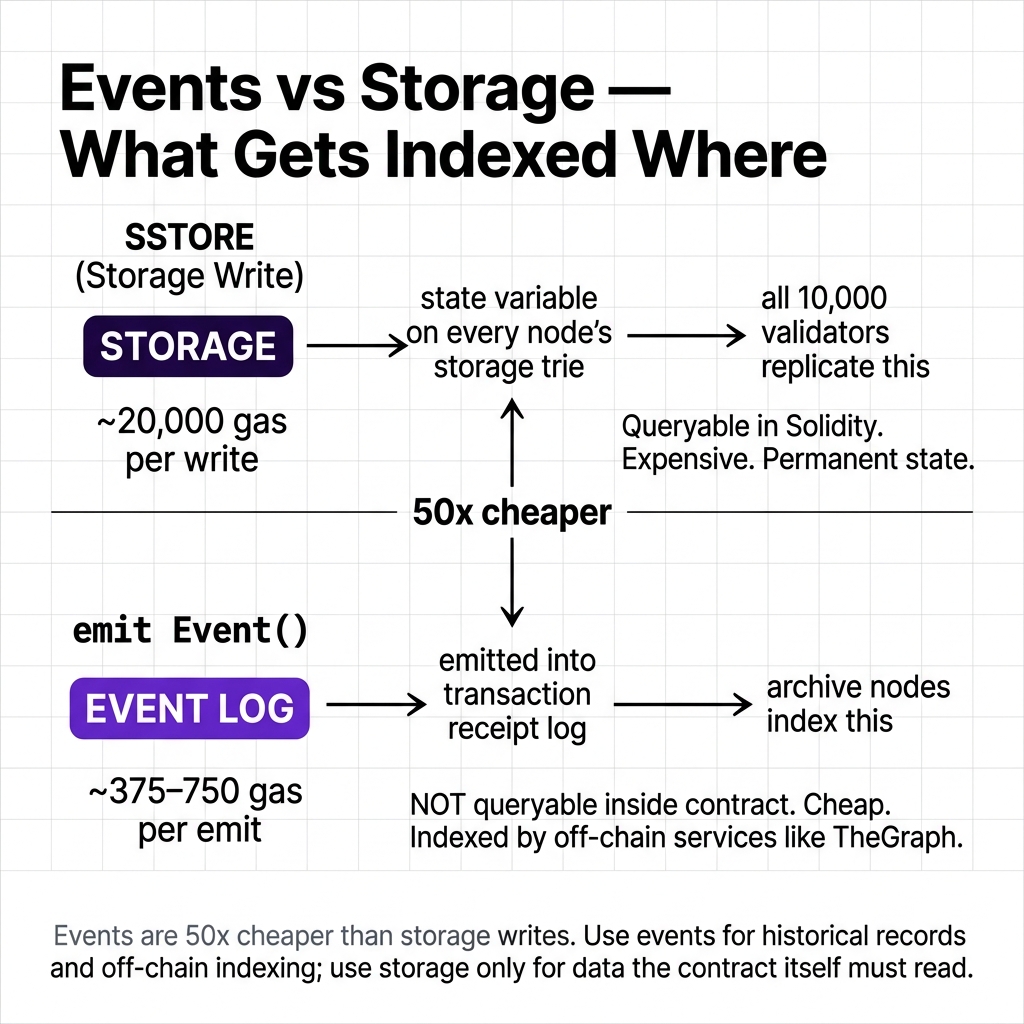
Emitting an event costs up to 100x less gas than writing to a state variable. Standard event emission (the LOG opcode) costs a flat 375 gas, plus 8 gas per byte of log data. By contrast, writing a single variable to storage (SSTORE) costs up to 20,000 gas. In production systems, you should emit events for history tracking and keep state variables strictly minimal!
2. Technical Breakdown: Log Structures & Indexed Parameters
Let's look at how events are implemented in Solidity:
- Indexed Parameters (
topics): By marking parameters asindexed(up to 3 per event), the EVM stores them in a specialized search index header called Topics. This allows frontends and indexers (like The Graph) to filter transactions matching specific values (e.g., "Find all events wheredonoris Alice") instantly, without downloading block headers. - Non-indexed Parameters: Placed in the
dataportion of the log. They are packed together, highly compressed, and cheap to store, but they cannot be filtered directly in queries.
The Silent Storage Trap: A common anti-pattern is pushing transaction details (like logs, timestamps, or receipts) to on-chain state arrays just to display them on a website dashboard. Always push those records to off-chain event logs instead. Pushing them to state arrays drains users' wallets on gas for zero functional benefit.
3. Summary of State vs. Events
| Feature | State Variables | Event Logs | | :--- | :--- | :--- | | Readable by Contracts? | Yes (during transaction) | No (Strictly off-chain) | | Searchable by Frontends? | No (only individual lookups) | Yes (via indexed topics / subgraphs) | | Gas Cost | Extremely Expensive | Ultra Cheap | | Lifecycle | Permanent state memory | Appended to transaction receipts |
Think about how an NFT marketplace (like OpenSea) displays a chronological list of bid updates, sales history, and price trends. Where does that history come from? Does the smart contract store all those bids in a massive array, or does it emit events that are indexable off-chain?
Was this lesson helpful?
Let us know what you think of this specification. (submitting anonymously)