
Common Beginner Security Mistakes
Origin authentication exploits, missing validations, and unsafe state assumptions.
Let's address the most common access control exploit in Solidity:
You are writing an authentication check to verify if the caller is the owner. You read the Solidity documentation and see there are two variables representing the sender: msg.sender and tx.origin. You think: tx.origin is awesome because it always reflects the physical person who clicked sign in MetaMask, rather than an intermediate contract. I'll use it for my ownership checks!
I genuinely made this exact mistake early on. I was shocked to find out that this simple decision leaves your contract wide open to phishing draining exploits.
Understanding the difference between tx.origin and msg.sender is critical to securing your contracts.
1. The Metaphor: The Spoofed Caller ID and the Proxy Agent
Imagine you have a secure voice-activated home security system:
msg.sender(Direct Caller): The security system looks at the person standing directly in front of the door holding the microphone. If your friend is standing there repeating commands for you, the system recognizes your friend's voice and rejects them.tx.origin(Original Caller ID): The system ignores the person holding the microphone and checks the caller ID of the telephone line that initiated the connection.- The Phishing Attack:
- An attacker builds a shiny phishing website offering a "Free NFT Claim."
- You open the website and click "Claim" (you initiate transaction
tx.origin). - The website's smart contract intercepts your call, acts as your intermediary proxy, and immediately calls the withdraw function of your home vault contract.
- Your home vault contract checks
tx.origin. It sees the call originally came from your MetaMask wallet, thinks everything is fine, and releases all your funds to the phishing contract!
tx.origin should never be used for access control or authentication check-ins. It is strictly a transaction tracing variable. If you use tx.origin for authorization, any user who interacts with a malicious smart contract can have their assets completely drained by that contract on your platform!
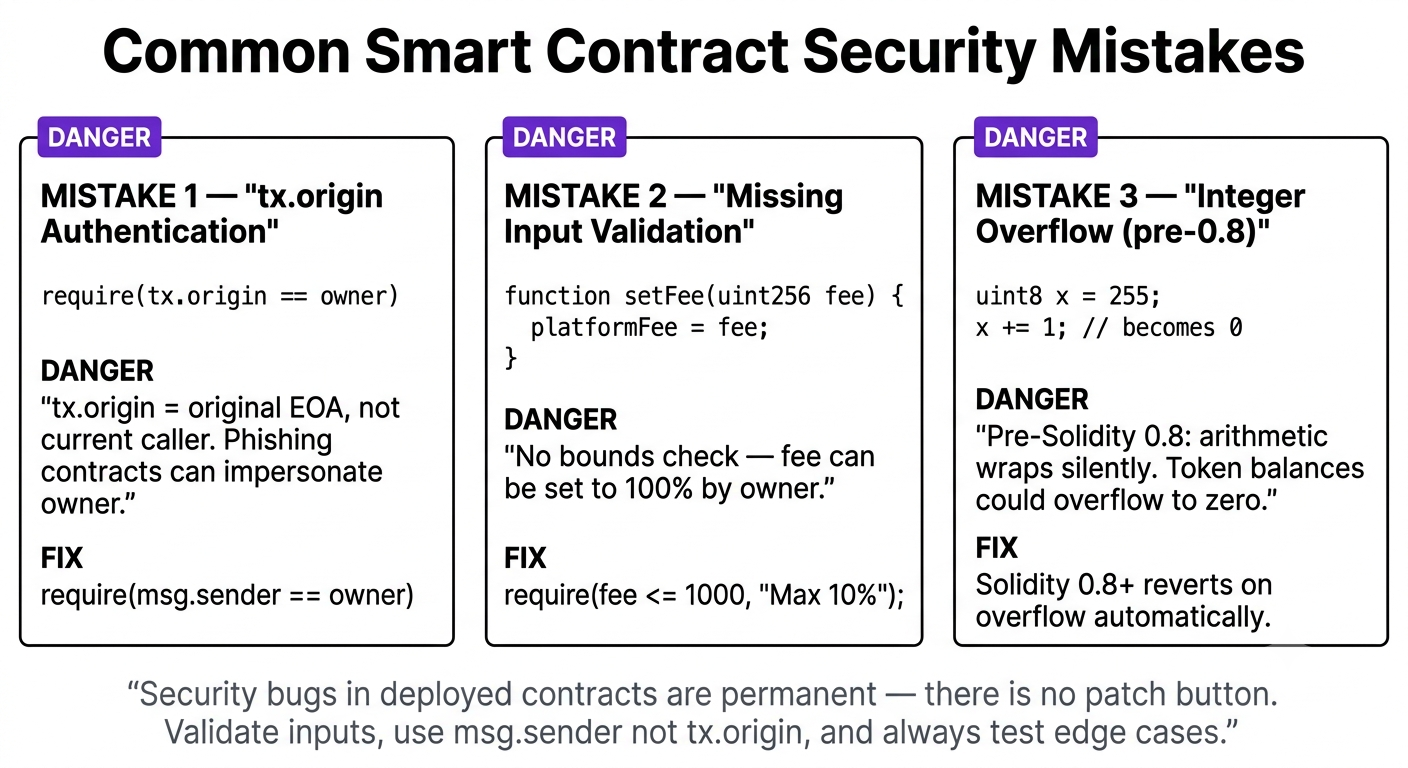
2. Technical Breakdown: tx.origin Phishing Exploit
Let's look at the vulnerable authentication vault code side-by-side with the phishing contract that exploits it:
- The Phishing Exploit: When the vault owner sends a transaction to
AttackPhishingContract(for example, thinking they are claiming a free token), the fallback function executes. It callsvault.withdrawAll(attacker). Inside the vault,tx.originis the owner's MetaMask address, so the require check passes, and all funds are sent to the attacker!
The Unchecked Return Value Trap: Another common beginner security mistake is failing to verify the success return values of raw ETH transfers (like msg.sender.send()). In Solidity, if send() fails, it does not throw a revert; it simply returns false. If you don't check it, the contract will continue executing its state changes as if the transfer succeeded, leading to massive accounting discrepancies!
3. Core Rules of Smart Contract Authentication
- Always use
msg.sender: It represents the immediate caller (which could be a contract or a wallet), shielding you from intermediate phishing proxies. - Never trust external inputs blindly: Always sanitize variables, check bounds, and verify return values.
- Keep validations local: Validate state parameters immediately at the entrance of your functions.
Trace the execution: If a user calls a contract ContractA, which in turn calls ContractB, identify what msg.sender and tx.origin will evaluate to inside ContractB. Who is the immediate caller and who is the transaction initiator?
Was this lesson helpful?
Let us know what you think of this specification. (submitting anonymously)