
Why People Trust Smart Contracts
How immutable code and public verification eliminate the need for centralized administrators.
Let's address the core psychological hurdle every traditional developer faces when entering the blockchain ecosystem:
In the Web2 world, trust is built on reputation, brands, and legal liability. You deposit money into a bank because the bank has a government license, a large office building, and legal contracts. You trust an API server because you believe the engineers who wrote it are competent and the company won't steal your credit card.
When you show a Web2 developer a smart contract and say: "I deployed this coin-flipping game, and users have deposited $50,000 into it," they look at you with total disbelief:
"Wait... if you are the one who wrote this code, how do I know you won't modify the rules tomorrow to make yourself win every flip? How do I know you won't write a secret back door to withdraw all their money?"
Understanding trust minimization is fundamental to understanding why Web3 systems can coordinate billions of dollars of capital across complete strangers without legal agreements.
1. The Metaphor: The Mechanical Vending Machine
To understand this paradigm shift, contrast a street merchant with a mechanical vending machine:
- The Street Merchant (Centralized Web2): You walk up to a merchant and ask for a soda. You hand them a dollar bill. You must trust that:
- They will actually hand you the cold soda.
- They won't charge you $5 instead of $1.
- They won't run away with your dollar. If they cheat you, you must call the police or sue them—relying on a slow, expensive centralized authority.
- The Vending Machine (Decentralized Web3): You walk up to a heavy, steel vending machine. The mechanical rules are visible through the glass: insert a coin, press button B4, and the spiral gear turns, dropping your soda.
- You do not care who built the vending machine.
- You do not care if the manufacturer is honest.
- The transaction is strictly guaranteed by physical gears and gravity. If you insert the correct coin and press B4, B4 will drop. The machine cannot change its price list on you mid-transaction. It cannot steal your dollar and tell you to come back next week.
A smart contract is a digital vending machine placed inside a globally replicated, public glass room (the blockchain).
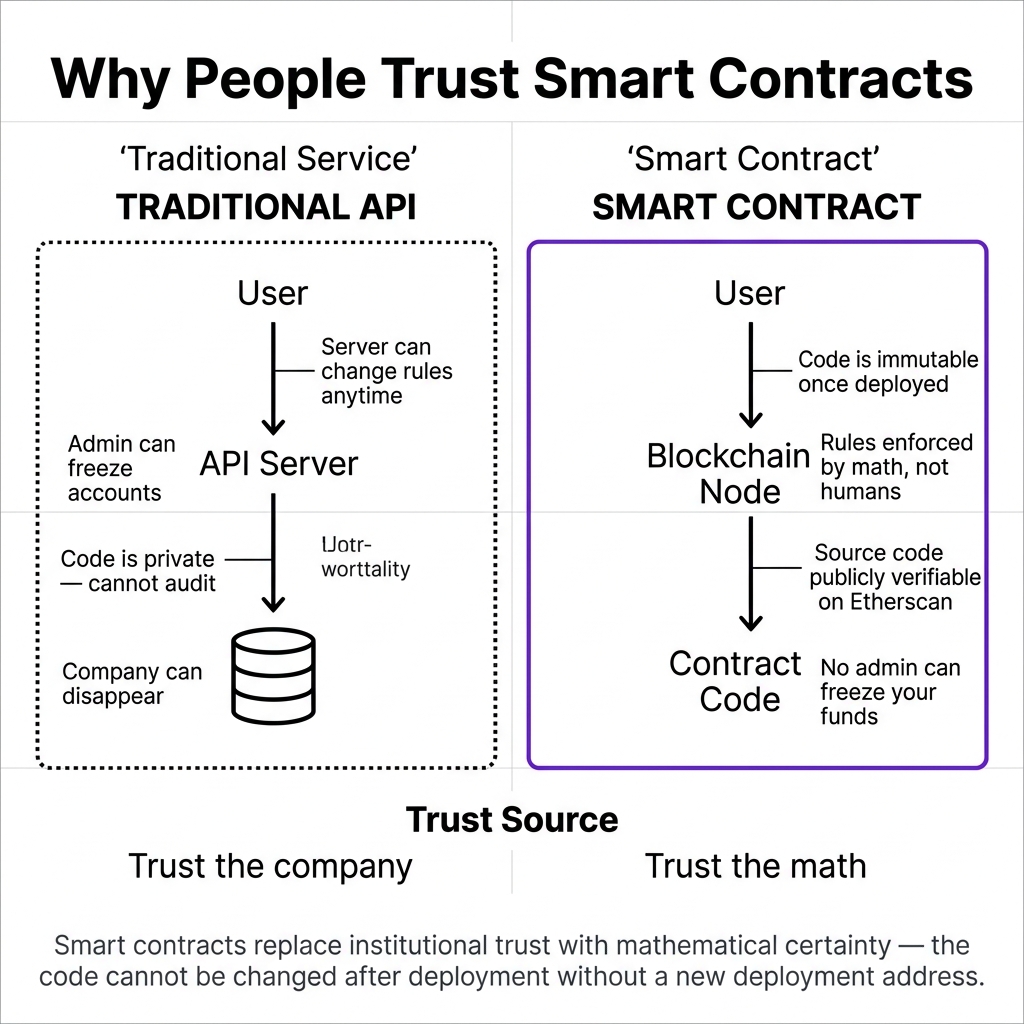
"Trustless" does not mean "perfect". A smart contract is trustless because its behavior is mathematically guaranteed by the code written in state. However, if the code contains a logic bug or a security vulnerability, that bug is also mathematically guaranteed to be exploitable. The machine will execute its rules exactly as chiseled, even if those rules lead to a total drainage of funds!
2. The Mechanics of Trust Minimization
How do we prove to a user that a smart contract is trustworthy? We rely on three distinct pillars:
1. Code Immutability
Once a contract's runtime bytecode is deployed to an Ethereum address, it is chiseled into the global ledger state permanently. No one—not even the original developer, the node validators, or the President of the United States—can modify a single byte of that code. The rules are locked forever.
2. Open-Source Bytecode Verification
Smart contracts are written in high-level languages like Solidity, but validators execute raw bytecode hex strings. To prove the bytecode matches the source, developers upload their human-readable Solidity files to public block explorers (like Etherscan). Etherscan compiles the source and verifies that the output matches the deployed bytecode. Anyone can read, audit, and run the exact contract code line-by-line.
3. Execution Guarantee (Consensus)
Transactions do not run on the developer's server. They execute inside sandbox EVM nodes across thousands of independent validators globally. A validator cannot cheat and return a fake result because their state transition would be rejected by other nodes, slashing their staked funds.
Think about a situation where a developer needs to fix a bug in their smart contract after deployment (for example, a logic vulnerability that was missed during testing). If the blockchain is immutable, how is this possible? Hint: look up "Upgradable Smart Contracts (UUPS)" and consider if this reintroduces a trust requirement.
Was this lesson helpful?
Let us know what you think of this specification. (submitting anonymously)