
Event-driven data loading — the correct pattern
Using contract events as the source of truth: historical replays, real-time WebSocket subscriptions, and the bridge to off-chain indexing.
After discovering that direct contract reads don't scale and that eth_getLogs has hidden limits, there's a middle-ground pattern that works well for medium-scale apps: event-driven data loading.
Instead of querying current state from contract storage (slow, expensive, doesn't support filtering), you listen to the events that the contract emits whenever state changes. Events are the blockchain's broadcast system — every state change announcement is permanently logged, cheap to store, and designed to be queried.
1. The Mental Model: Events as the Notification Bus
In ChainElect, every significant state change emits an event:
These events are your notification bus. They tell the frontend exactly what happened, when it happened, and who triggered it — without requiring any additional RPC calls to reconstruct state.
The key insight: if you build your frontend state by replaying and listening to events, you only need to query events (not raw state), and you can maintain that state incrementally as new events arrive.
2. The Visual: Event-Driven State Machine
[!TIP] VISUAL TRIGGER FOR FRONTEND: Animate the initial load as a "replay" — show historical events streaming in and building up a state object like a ledger. Then show the real-time subscription as a live wire that updates the same state object in place. This helps students understand state reconstruction from events vs polling contract state.
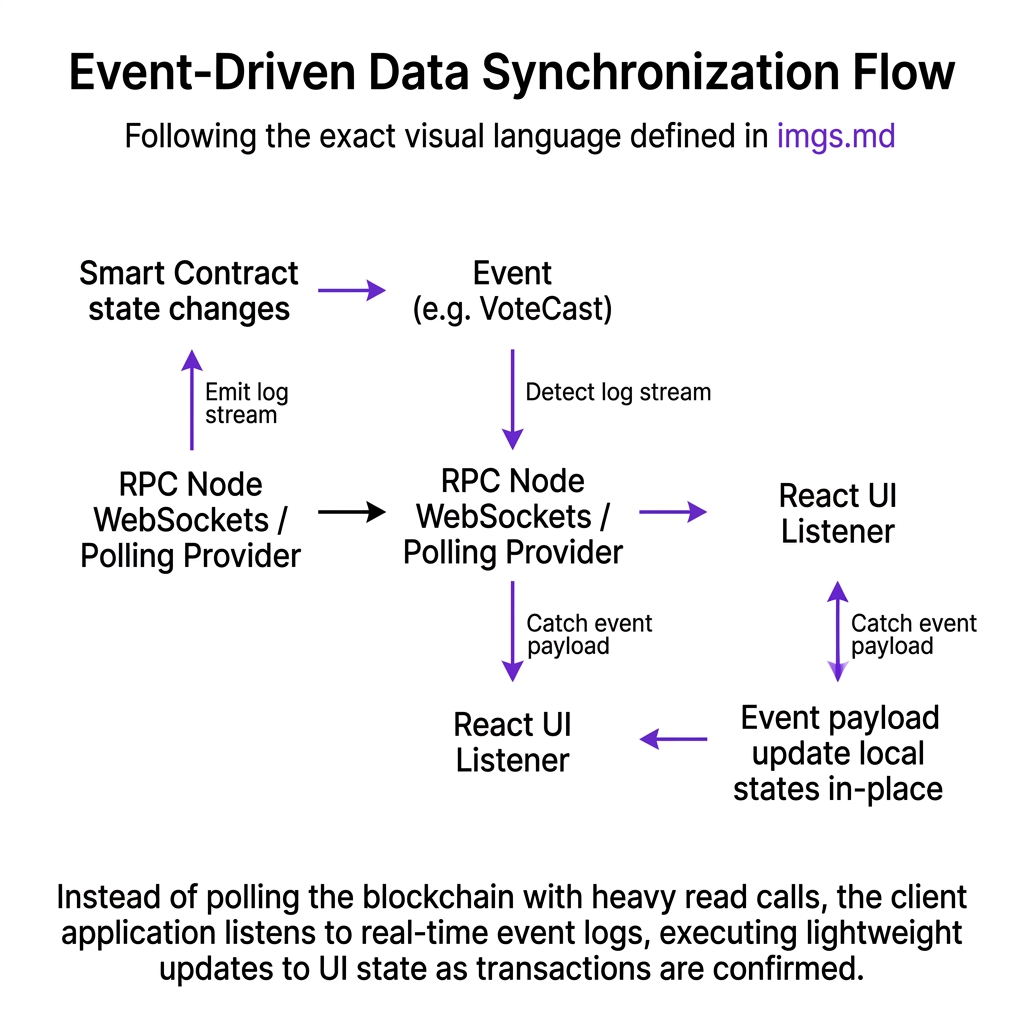
3. Technical Explanation: Web3.js Event Subscriptions
Web3.js supports both historical event queries and real-time event subscriptions:
This pattern:
- Historical load: one paginated
eth_getLogsquery (still has limits, but manageable at medium scale) - Real-time updates: WebSocket subscription (no RPC calls for new events)
- No polling loop required
4. The Bridge to Indexing
Event-driven loading works well up to ~50,000 historical events or ~10,000 blocks of history. Beyond that, the initial historical replay becomes too slow.
This is the exact moment where The Graph (Module M2.5) becomes necessary. Instead of replaying events in the browser on every page load, The Graph does the replay once, stores the result in a PostgreSQL-backed subgraph, and exposes a GraphQL API for instant queries.
The event-driven pattern you're learning now is the conceptual foundation of how indexers work — they do the same replay, just once, off-chain, and much faster.
Web3.js WebSocket subscriptions only work when connected to a WebSocket-enabled RPC endpoint (like wss://polygon-amoy.g.alchemy.com/v2/KEY). Standard HTTP RPC endpoints (https://...) do not support real-time event subscriptions. Always check your RPC endpoint supports WebSocket when building live-updating UIs.
In ChainElect's contract, identify which events are marked as indexed (e.g. Voted(address indexed voter, uint256 indexed candidateId)). Why does marking an event parameter as indexed matter for querying? Try filtering getPastEvents('Voted', { filter: { candidateId: '1' } }) — would this work without the indexed keyword?
Was this lesson helpful?
Let us know what you think of this specification. (submitting anonymously)