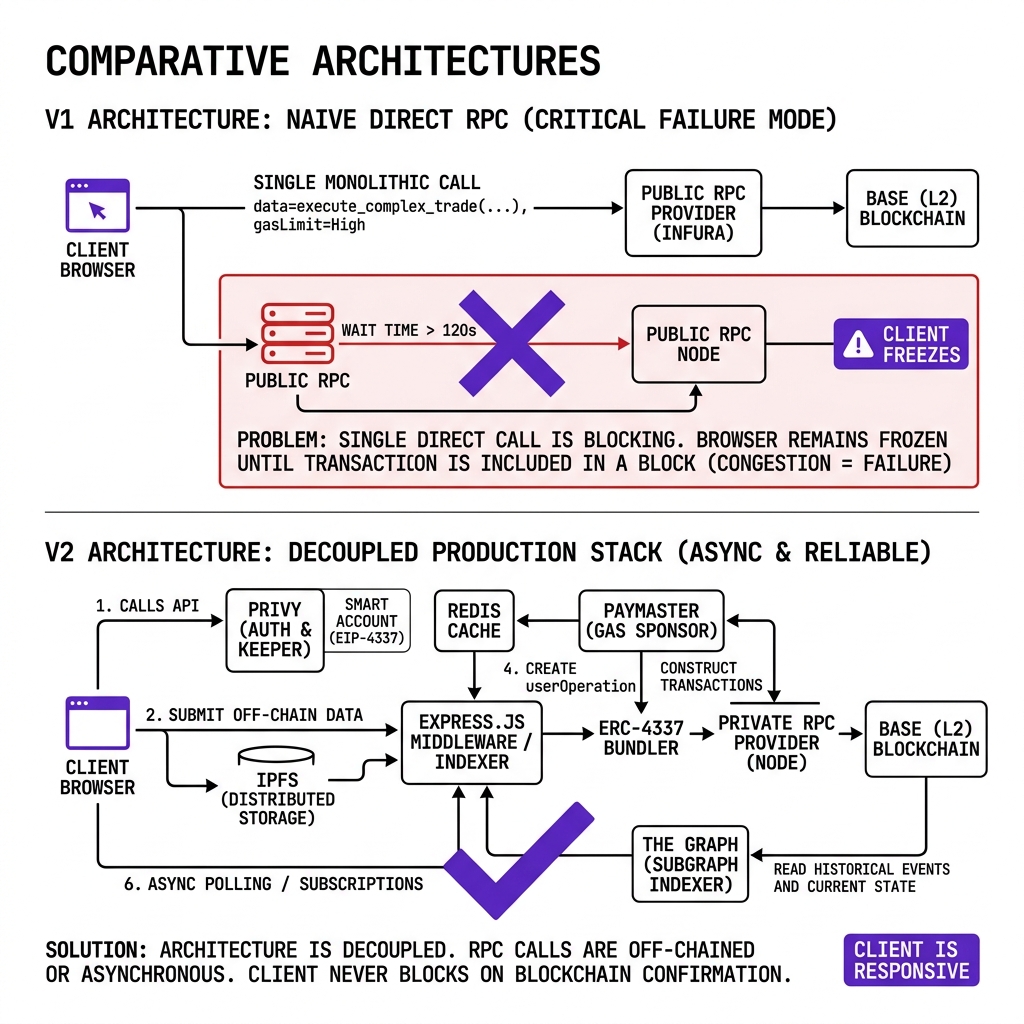
T3/M3.5/Socio3 autopsy — from naive RPC to decoupled production stack
intermediate 16m read
Socio3 autopsy — from naive RPC to decoupled production stack
A postmortem on Socio3: tracing how direct JSON-RPC queries froze the browser at 1,000 posts, and how we rebuilt it using Privy, ERC-4337, The Graph, and Redis.
#autopsy #socio3 #rpc #the-graph #caching #ux
Socio3 V1 failed by querying state arrays directly via RPC. Socio3 V2 introduces Privy authentication, paymasters, caching gateways, and subgraphs to deliver a responsive feed.
When I built Socio3 V1, my goal was ideological purity: a fully decentralized social media application where posts, profile links, and interactions occurred directly on-chain, and the frontend read the blockchain state live.
In theory, it was beautiful.
In production, it was unusable.
With 20 users during my initial demo, the site was sluggish but worked. But when we shared the link at a developer meet-up and hit 500 posts, the page took 4.5 seconds to load. At 1,200 posts, the main browser thread froze entirely, causing Safari and Chrome to display a "Page Unresponsive" warning.
This is the autopsy of how direct client-to-blockchain architectures fail at scale, and how we refactored Socio3 into a decoupled, hybrid production stack.
Socio3 V1 relied on direct smart contract reads using public RPC providers. To load a social feed, the frontend executed the following:
The Read Call: Call contract.methods.getAllPosts().call().
The RPC Ceiling: The JSON-RPC request carried a massive payload containing hundreds of post structures (CIDs, author addresses, timestamps). Alchemy rate-limited our API keys because the serialization overhead was too high.
Client-Side Sorting: The frontend received the raw array. Because smart contracts cannot easily index or sort arrays, the browser had to loop through, parse, sort by timestamp, filter deleted entries, and fetch the IPFS gateway links sequentially.
The Gate Latency: The browser fetched images directly from a public IPFS gateway, adding 3–5 seconds of DHT network lookup time per post.
Furthermore, we lost 80% of our registration conversions because the signup flow forced users to install MetaMask and write down a seed phrase.
2. The Refactoring: Socio3 V2 Decoupled Stack
We realized the blockchain's job is not database querying or storage; its job is immutable validation. We rebuilt Socio3 from the ground up by separating the Write Path, the Read Path, and the Caching layers.
Embedded Wallets: We integrated Privy to allow standard Google, Apple, or email logins. Upon auth, Privy generated a secure, sharded key pair on the device.
Account Abstraction (ERC-4337): We mapped the generated key to a Smart Account. When the user posted or liked, they signed a UserOperation instead of a transaction.
Gas Sponsorship: The UserOp was routed to a Pimlico Paymaster, which sponsored the gas fees. The user signed up and posted in under 15 seconds without owning a single coin or seeing a wallet popup.
The Read Path (Performance Resolution):
The Graph Indexing: We stopped calling getAllPosts() directly on the contract. Instead, we wrote a Subgraph that indexed the contract's event logs (PostCreated). The Graph node processed these events, parsed the IPFS JSON schemas, and structured them in an index database.
GraphQL Queries: The frontend loaded feeds via a single, paginated GraphQL query:
SmartAccount.sol
graphql
query { posts(first: 10, orderBy: timestamp, orderDirection: desc) { id author text imageUrl } }
Feed load time dropped from 4.5 seconds to 35 milliseconds.
IPFS Caching: We set up an Express API Gateway proxy coupled with Upstash Redis to cache the media files. Once a CID was retrieved from IPFS, it was cached in Redis for future requests, dropping image render times to under 80ms.
3. Live From the Repo: Socio3's Actual V2 Architecture
Don't take my word for it — here's the actual system architecture docs from the Socio3 repository, with every contract address, every service layer, and the real identity model we shipped:
And here's how the V2 identity model actually works — the dual EOA + Smart Account system:
// I Got This Wrong
The Direct RPC dependency:
Assuming an RPC provider (like Alchemy, Infura, or QuickNode) can act as your main database query engine is a fatal architectural mistake. RPC nodes are designed to validate and route state mutations, not to run heavy queries or custom sorting. Any data that needs to be displayed in a feed must go through an indexing layer.
— Postmortem Confession
System Design Challenge
Think Active
Analyze the frontend loading lifecycle of your dApp. Open the Network tab in your browser console. How many JSON-RPC requests (eth_call) does your page make on load? Can you consolidate these calls into a single query or migrate them to a Graph subgraph? Sketch the decoupled flow on your design board.
[ Think Before Continuing ]
Was this lesson helpful?
Let us know what you think of this specification. (submitting anonymously)