RoadToChain Logo
RoadToChain
T3/M3.3/Why The Graph exists — indexing deep dive
intermediate 15m read

Why The Graph exists — indexing deep dive

EVM storage contains no ORDER BY or query features. How to compile smart contract events into instantly queryable GraphQL endpoints.
#indexing #the-graph #graphql #queries
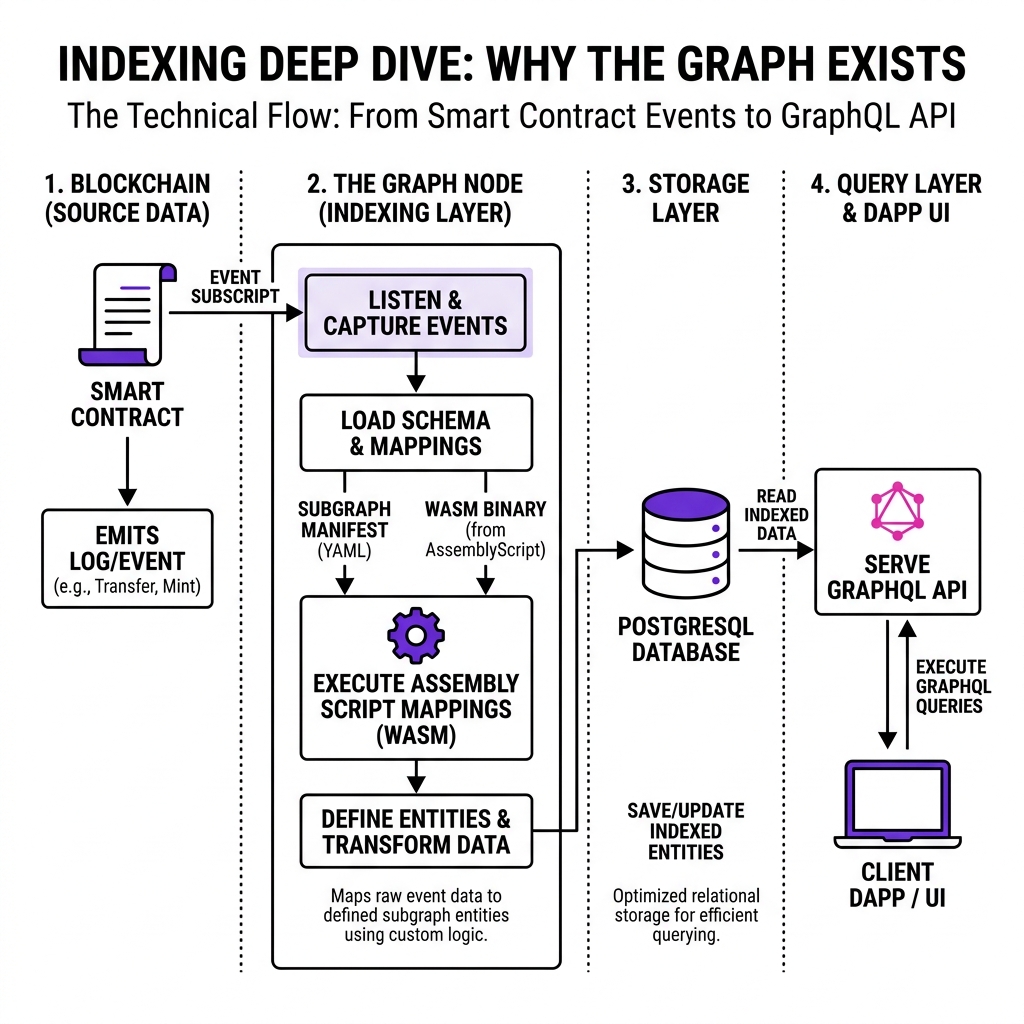
How The Graph Subgraph Sync Pipeline Works
Solidity has no native query engine. The Graph listens to emitted blockchain events and maps them via AssemblyScript handlers into an instantly queryable GraphQL database.

If you are a web developer coming from MySQL or MongoDB, you are used to writing queries like this:

SmartAccount.sol
sql
SELECT * FROM posts WHERE author = '0x123...' ORDER BY timestamp DESC LIMIT 10;

When you transition to smart contract development, you hit a massive wall: Solidity has no query engine.

Smart contract storage is a key-value store optimized for state transitions, not reading. There is no ORDER BY, no LIMIT, and no text indexing.

If you want to render a home feed of posts from the users you follow, your frontend would have to fetch all posts from the blockchain and sort/filter them in memory. This is completely unscalable.

This is why The Graph was invented.


1. The EVM Query Limitation

Let's look at how posts are stored inside PostContract.sol:

SmartAccount.sol
solidity
struct Post {
    uint256 id;
    address author;
    string ipfsHash;
    uint256 timestamp;
}
 
mapping(uint256 => Post) public posts;
uint256 public totalPosts;

If your frontend wants to show "the latest 10 posts uploaded by Alice," the only native way to do it is:

  1. Query totalPosts to find the highest index.
  2. Run a loop in React fetching every post one-by-one (posts[1], posts[2], etc.).
  3. Filter out posts where author != Alice.
  4. Sort by timestamp.

If there are 50,000 posts in the system, this process requires 50,000 RPC requests, crashing the user's browser.


2. How The Graph Solves the Read Problem

Instead of reading contract storage directly, The Graph monitors blockchain events and compiles them into a structured database.

SmartAccount.sol
text
Solidity Contract ──▶ emits PostCreated() Event ──▶ Polygon Block Log

                                                    The Graph Node

                                                AssemblyScript Mapping

                                                PostgreSQL Database

                                                   GraphQL Endpoint

3. The Subgraph Specification (subgraph.yaml)

To index Socio3, we configure a subgraph mapping to listen for the PostCreated event on Polygon Amoy:

subgraph.yaml
yaml
# subgraph.yaml
specVersion: 0.0.5
schema:
  file: ./schema.graphql
dataSources:
  - kind: ethereum
    name: PostContract
    network: amoy
    source:
      address: "0x5d5C1d313f580027204e04E8D4E3162f37A661CF"
      abi: PostContract
    mapping:
      kind: ethereum/events
      apiVersion: 0.0.7
      language: wasm/assemblyscript
      entities:
        - Post
      abis:
        - name: PostContract
          file: ./abis/PostContract.json
      eventHandlers:
        - event: PostCreated(indexed uint256,indexed address,string)
          handler: handlePostCreated
      file: ./src/mapping.ts

4. The Mapping Handler (mapping.ts)

When a PostCreated event occurs, the Graph node executes an AssemblyScript function to update its local database:

types.ts
typescript
// src/mapping.ts
import { PostCreated as PostCreatedEvent } from "../generated/PostContract/PostContract"
import { Post } from "../generated/schema"
 
export function handlePostCreated(event: PostCreatedEvent): void {
  // Create a new database record (entity)
  let post = new Post(event.params.postId.toString());
  
  post.author = event.params.author;
  post.ipfsHash = event.params.ipfsHash;
  post.createdAt = event.block.timestamp;
  post.likeCount = 0;
  post.tipTotal = 0;
  
  // Save to indexer's database
  post.save();
}

5. Querying the Indexer

Now, the client can query Alice's posts using standard GraphQL:

SmartAccount.sol
graphql
query GetAlicesPosts {
  posts(
    where: { author: "0xAliceAddress..." }
    orderBy: createdAt
    orderDirection: desc
    first: 10
  ) {
    id
    ipfsHash
    createdAt
  }
}

The Graph processes this query in under 50ms, returning exactly the 10 posts Alice created.


// Reality Check

The Graph is a READ cache. It does not replace the blockchain. Write actions (sending tokens, creating posts) must still go through smart contract transactions. The Graph is strictly for indexing those actions after they occur.

— Production Engineering Principle

System Design Challenge
Think Active

If a user unfollows another user in Socio3, how does The Graph update the social graph? Sketch the schema and handler mappings required to delete or update a follow relation entity.

[ Think Before Continuing ]

Was this lesson helpful?

Let us know what you think of this specification. (submitting anonymously)