
Mainnet vs testnet — NOT the same thing
Why ETH costs $3,000 but Sepolia ETH is free. Chain IDs, faucets, token economics, and why Polygon is cheap. The value mental model every beginner needs.
I'll never forget the moment of confusion: I had just deployed my first smart contract to Sepolia testnet. MetaMask showed "0.1 ETH" in my wallet. For about thirty seconds, I genuinely thought I had real money. I even started calculating what 0.1 ETH was worth in dollars.
I literally spent an hour searching for cross-chain bridges or looking up if I could sell my testnet Sepolia ETH on Uniswap for real USDT, thinking I had discovered the ultimate cryptographic loophole to get rich quick.
Then the hard reality hit me: Sepolia ETH is completely, 100% worthless. Anyone can get unlimited amounts for free from a faucet. The "0.1 ETH" in my wallet was monopoly money.
But this led me to a much deeper question that took weeks to fully understand: Why does mainnet ETH have value at all? Who decides that 1 ETH is worth $3,000? And why is Polygon so much cheaper than Ethereum?
1. The Problem: Same Interface, Completely Different Realities
Open MetaMask. Switch between Ethereum Mainnet and Sepolia Testnet. The UI looks identical. The wallet shows "ETH" in both cases. Transaction confirmations look the same. Contract interactions work the same way.
But one costs real money. The other is completely free. Same code. Same tools. Same wallet. Completely different economic reality.
This is deeply confusing for beginners. And the confusion leads to real mistakes: deploying production contracts to testnets, confusing chain IDs, sending real tokens to testnet addresses, or — worst of all — deploying untested contracts directly to mainnet.
2. Layman Explanation: Monopoly Money vs Real Cash
Imagine two poker games running in the same casino:
Table 1 (Mainnet): Everyone bought in with real cash. The chips represent actual dollars. Security guards watch every hand. Cheating means losing your $50,000 deposit. Every player is invested, attentive, and serious.
Table 2 (Testnet): Everyone plays with free chips from the house. No money at risk. No security guards. If someone cheats, the worst that happens is the table gets reset. Players experiment with wild strategies they'd never try with real money.
The cards, the rules, the table, and the dealer are identical at both tables. The only difference is what's at stake. And that difference in stakes creates entirely different behaviors.
This is exactly the relationship between mainnet and testnet.
3. Technical Explanation: What Creates Value?
“If testnet works, why not use it forever?”
Testnet ETH has no value, so nobody has economic incentive to attack it. Real attacks on real money only happen on mainnet. Security assumptions that hold on testnet can fail on mainnet under real economic pressure.
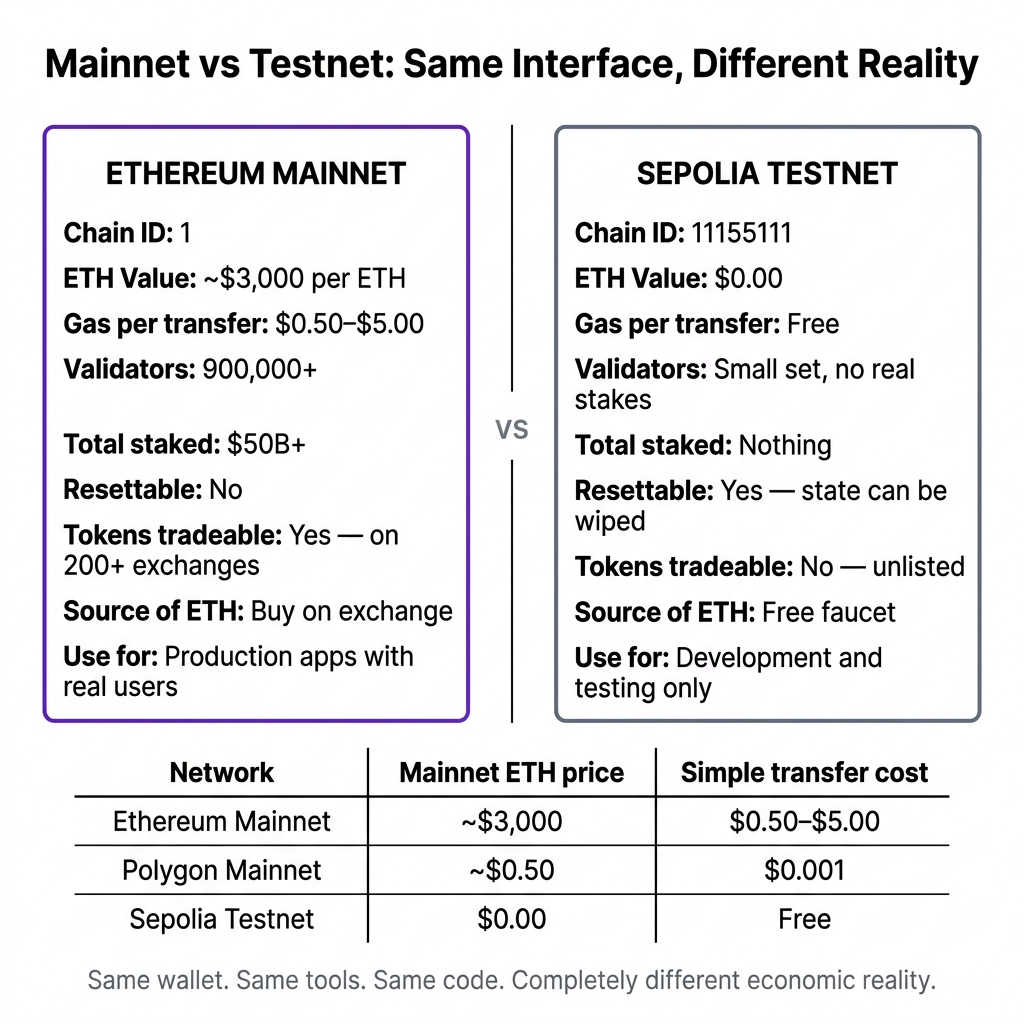
Why Mainnet ETH Has Value:
-
Real Economic Stakes: Validators on Ethereum lock up 32 ETH (~$96,000) as collateral. If they cheat or go offline, their stake gets "slashed" (destroyed). Over $50 billion in total value is staked across the network.
-
Scarce Block Space: Each Ethereum block has limited computational capacity. When demand exceeds supply (during NFT mints, DeFi events), gas prices spike. Users compete for inclusion by paying higher fees.
-
EIP-1559 Burn Mechanism: Since the London hardfork, the base fee portion of every transaction fee is permanently burned (removed from circulation). On high-activity days, more ETH is burned than issued — making ETH deflationary.
-
Market Consensus: ETH is traded on hundreds of exchanges. The price is set by global supply and demand. Real businesses, protocols, and DeFi platforms require ETH for operations.
-
Security Budget: The value of ETH directly funds network security. Higher ETH price → higher staking rewards → more validators → more security.
Why Testnet ETH Has Zero Value:
- No Stakes: Anyone can run a testnet validator with no real collateral.
- Unlimited Supply: Faucets mint testnet tokens on demand, for free.
- No Burns: No economic mechanism removes testnet tokens from supply.
- No Market: Testnet tokens aren't listed on any exchange.
- Resettable: Testnet chains can be reset, wiping all state.
4. Why Polygon Is Cheap (and Ethereum Is Expensive)
This is another question that confused me for weeks: if Ethereum and Polygon run the same EVM code, why are Polygon transactions 1000x cheaper?
The answer is block space supply and demand:
| Factor | Ethereum Mainnet | Polygon PoS | |--------|-----------------|-------------| | Block time | ~12 seconds | ~2 seconds | | Block gas limit | 30M gas | 30M gas | | Blocks per minute | ~5 | ~30 | | Gas supply per minute | ~150M gas | ~900M gas | | Network demand | Very high (DeFi, NFTs) | Lower | | Gas price | 20-100+ gwei | 30-50 gwei | | Simple transfer cost | $0.50-5.00 | $0.001-0.01 |
Polygon has 6x more block space per unit time, and significantly lower demand. More supply + less demand = cheaper prices. It's basic economics applied to computational resources.
But there's a tradeoff: Polygon has fewer validators (~100 vs Ethereum's ~900,000), less economic security, and shorter finality guarantees. You get cheaper transactions, but with less decentralization.
5. Faucets: Where Free Tokens Come From
A faucet is simply a smart contract (or web service) that sends testnet tokens to anyone who requests them:
Popular faucets: Alchemy Sepolia Faucet, Infura Sepolia Faucet, Google Cloud Sepolia Faucet. All free, all limited to prevent abuse.
In production, always double-check your chain ID before deploying contracts. Deploying to mainnet when you meant testnet wastes real money. Deploying to testnet when you meant mainnet means your users can't find your contract. I've seen teams waste hundreds of dollars deploying test contracts to Ethereum mainnet because of a misconfigured environment variable.
Deployed my first contract to Sepolia and briefly thought I had real money when MetaMask showed "0.1 ETH." The 0.1 Sepolia ETH was free from a faucet. It has zero real-world value. Worse: I then tested everything on Sepolia and assumed mainnet would behave identically. It didn't — gas costs on mainnet were 100x higher, and some transactions that were cheap on testnet exceeded users' gas budgets on mainnet.
"If Polygon gas is so cheap, why doesn't everyone just use Polygon?"
Three reasons: (1) Liquidity — most DeFi liquidity lives on Ethereum mainnet. (2) Security — Ethereum has 900,000+ validators securing $50B+ in stakes; Polygon has ~100 validators. (3) Composability — many protocols only exist on Ethereum mainnet, and cross-chain bridges introduce risk. For consumer apps, Polygon is excellent. For high-value DeFi, Ethereum's security premium is worth the cost.
Go to the Alchemy Sepolia Faucet (https://sepoliafaucet.com) and request free testnet ETH. Then open Etherscan for Sepolia (sepolia.etherscan.io) and find the faucet contract that sent you the tokens. Look at how many transactions it processes daily. Now ask: why would anyone spend engineering effort maintaining a faucet for tokens that have zero value?
Visual Blockchain Simulator
The Visual Blockchain Simulator includes a Network Comparator panel showing Ethereum vs Polygon vs Testnet side-by-side: block times, gas costs, validator counts, and economic security. This lesson's value mental model is the conceptual backbone of that comparison widget.
- Node propagation
- P2P communication
- Block formation
- Gas fee mechanics
Was this lesson helpful?
Let us know what you think of this specification. (submitting anonymously)