
What blockchain actually invented
Not just a database. A consensus mechanism for untrusted parties. The Nakamoto breakthrough.
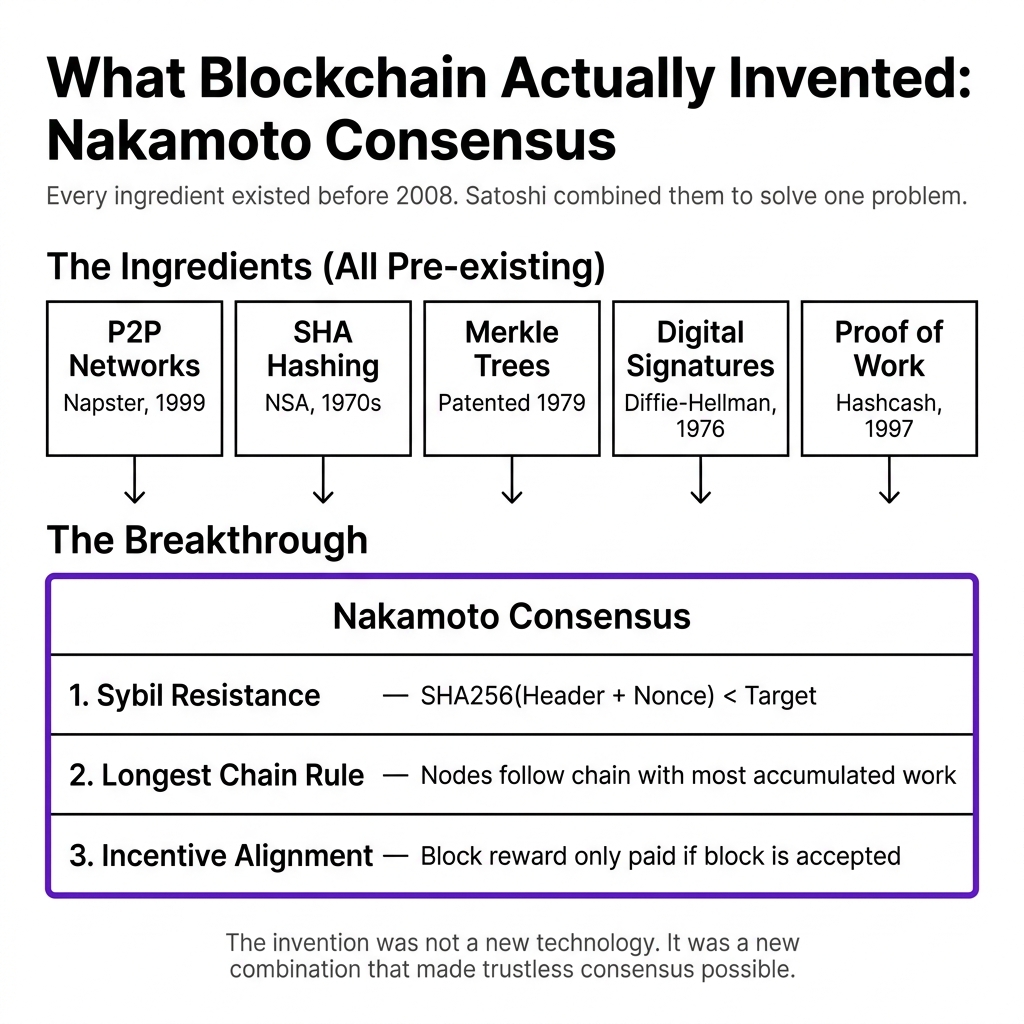
Many people think blockchain is a revolutionary database. It isn't. If you look closely, almost all the components of a blockchain were invented decades before Bitcoin:
- Peer-to-peer networks (Napster, Gnutella) were common in the late 1990s.
- Cryptographic hashing (SHA family) was invented in the 1970s.
- Merkle trees (hashing trees) were patented in 1979.
- Digital signatures (public/private keys) were invented in the 1970s.
- Hashcash (Proof of Work concept) was invented in 1997.
So if all the ingredients existed, what did Satoshi Nakamoto actually invent in 2008?
Satoshi's breakthrough was combining these pre-existing parts to solve a single, massive computer science problem: distributed consensus without a central authority.
1. The Real Invention: Nakamoto Consensus
In computer science, getting multiple independent computers to agree on a single database state is called the Consensus Problem.
For decades, we had protocols like Paxos or Raft that solved this, but they had a major limitation: they only worked in private environments where all computers trusted each other (or were run by the same company). They were vulnerable to malicious actors.
Satoshi solved this in a public, hostile environment by introducing a dynamic combination of Proof of Work and Game Theory.
Instead of trusting a name or IP address (which can be easily faked), Nakamoto Consensus forces nodes to prove they have expended real-world physical resources (computational energy) to participate.
2. Layman Explanation: The Giant Ledger Lottery
Imagine 100 scribes sitting in a room, trying to write the official history of a kingdom. Every 10 minutes, a bell rings and they need to decide which scribe's page of notes is added to the official book.
- If they vote, one scribe can bring 500 fake friends into the room and outvote the rest (a Sybil attack).
- If they appoint a leader, that leader might cheat or go missing.
To solve this, the King introduces a game: Every time the bell rings, the King gives them a complex math riddle (like solving a giant jigsaw puzzle). The first scribe to solve the riddle shouts "I solved it!", displays their solution, and passes around their page of notes.
The other scribes verify the solution (which takes only a second) and check if the notes are correct. If the notes are correct, they write the solution's number at the top of their own page and start solving the next riddle.
Because solving the riddle requires real time and effort, scribes cannot cheat easily. If a scribe writes fake entries, the others will reject their page, and the cheating scribe will have wasted all their riddle-solving energy for nothing. The math riddle aligns their economic self-interest with honest behavior.
3. Technical Explanation: Combining Cryptography & Incentives
Nakamoto Consensus aligns three distinct layers:
-
Proof of Work (Sybil Protection): Nodes (miners) compete to find a block hash that is lower than a target difficulty threshold. To find it, they must hash the block header repeatedly with a random number (nonce):
SmartAccount.solThis requires brute-force computing power. It prevents Sybil attacks because an attacker cannot fake computational work.
-
The Longest Chain Rule (Chain Selection): If two miners find a valid block at the same time, the network temporarily splits. Satoshi resolved this with a simple rule: Nodes must always follow the chain with the most accumulated Proof of Work (the "longest" chain). Over time, one branch will inevitably grow faster than the other, and all nodes will switch to that branch, resolving the split deterministically.
-
Incentive Alignment (Economic Game Theory): Miners are rewarded with newly minted coins (block rewards) and transaction fees. But these rewards are only valid if the block is accepted by the other nodes. If a miner tries to include a double-spend or invalid transaction, the other nodes reject the block. The miner gets no reward and loses the electricity money they spent mining.
Many Web3 advocates say blockchain represents the "death of trust." This is misleading. Blockchain doesn't eliminate trust; it shifts it. You stop trusting human bank managers or databases, and start trusting laws of mathematics, cryptography, and economic incentives.
Explain in your own words why an attacker cannot simply create 10,000 virtual machines in the cloud to outvote honest nodes in a Proof of Work network. What physical constraint stops them?
Visual Blockchain Simulator
In the Visual Blockchain Simulator, you will write a simple hashing puzzle visualizer that simulates how mining difficulty changes as nonces are updated, illustrating the core math of Nakamoto consensus.
- Node propagation
- P2P communication
- Block formation
- Gas fee mechanics
Was this lesson helpful?
Let us know what you think of this specification. (submitting anonymously)